
Garfield Projected and Actual Release Dates
A projected release date is an estimate produced while a sentence is being administered. It can reflect the sentence, credit already earned, the current earned-credit level, and other known terms. An actual release date records a completed custody exit. Those two dates answer different questions. The projection says what may happen if current assumptions hold. The actual date says when the responsible agency completed release or discharge.
Pretrial detention works differently. A person held at the Garfield County Detention Facility while a case is pending does not have a sentence-based release date to calculate. Release can turn on bond, dismissal, a court order, transfer, or resolution of another hold. The live GCCJA roster shows current names and booking dates but publishes no projected or actual release field. Court action can authorize release before staff finish checks and processing.
A sentenced county-jail detainee and an ODOC prisoner also use different records. GCCJA records the county custody exit. ODOC calculates a state sentence and maintains the state custody or supervision record. A transfer from Garfield County to ODOC removes the person from the county roster but continues confinement.
Find a Garfield County Projected Release
Start by identifying whether the person is in county detention, ODOC custody, or another system. The GCCJA operator page links the active county list. The OK Offender Lookup covers people accepted into ODOC custody or supervision. Neither system can stand in for the other.
- Check the Garfield County active list and preserve the exact name and booking date. If the person appears there awaiting court action, do not assign a fixed projected release date.
- Review the Garfield County case through OSCN or the Court Clerk's ODCR route. Find bond action, judgment and sentence, later amendments, or orders that may affect custody.
- If the county record indicates transfer to ODOC, search by DOC number. Otherwise, compare full name, date of birth, aliases, offense, and case information before accepting a match.
- Inspect the public ODOC profile for its current labels. Do not assume every profile exposes a projected date, and record the date on which the profile was checked.
- When the public view is incomplete, use facility records staff, the inmate's case manager, or the appropriate ODOC records route. For county custody, ask GCCJA for the existing jail record and the actual discharge information when release occurs.
- After any projected date passes, obtain a current status, parole result when relevant, or discharge record. An old estimate cannot prove release.
The official OK Offender Lookup landing screen below is the state-search entry used for an ODOC record.
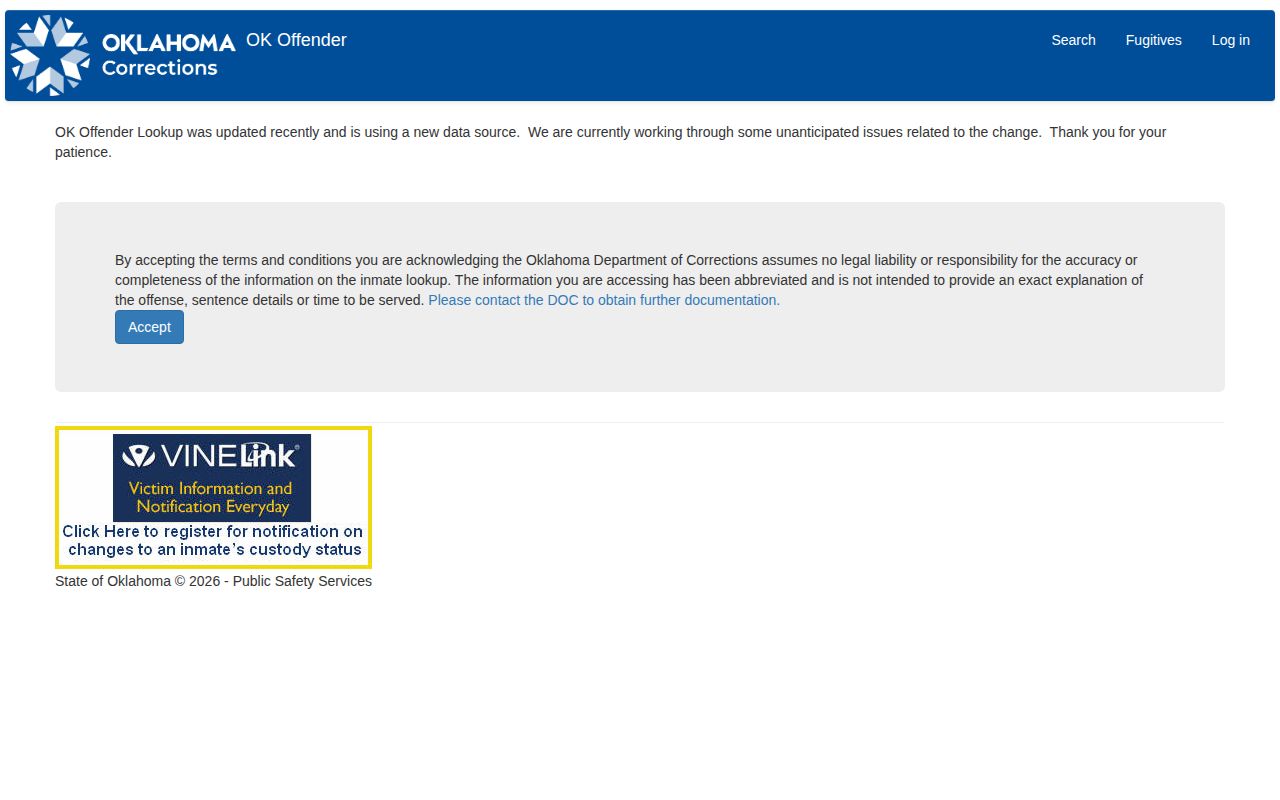
The search accepts a DOC number, first and last name, date of birth, aliases, and a similar-sounding-name option after disclaimer acceptance. A DOC number is the strongest starting key. A common-name result needs comparison with the Garfield County case before it can be treated as the right person.
The broader Garfield County release-record path explains how GCCJA, the court, and any receiving agency fit together when a person leaves the local roster.
Garfield Release Date Confidentiality Limits
Oklahoma's official material contains a tension that must remain visible. ODOC policy OP-030117 has directed recipients of inmate mail to Offender Lookup for information that includes an offense, photograph, and projected release date. Yet ODOC's current Offender Info FAQ says release-date information is confidential without legitimate need. It says an inmate receives a monthly days-remaining figure and can seek help from facility records staff or a case manager.
The sound conclusion is limited. OK Offender Lookup is the right public profile to inspect for a state prisoner, but no one should be promised that every result will show a projected date. If a date is displayed, it remains tentative. If no date appears, that silence does not mean the person has no calculation or will never be released.
The official ODOC Offender Info page shown below states the agency's present release-date qualifications.
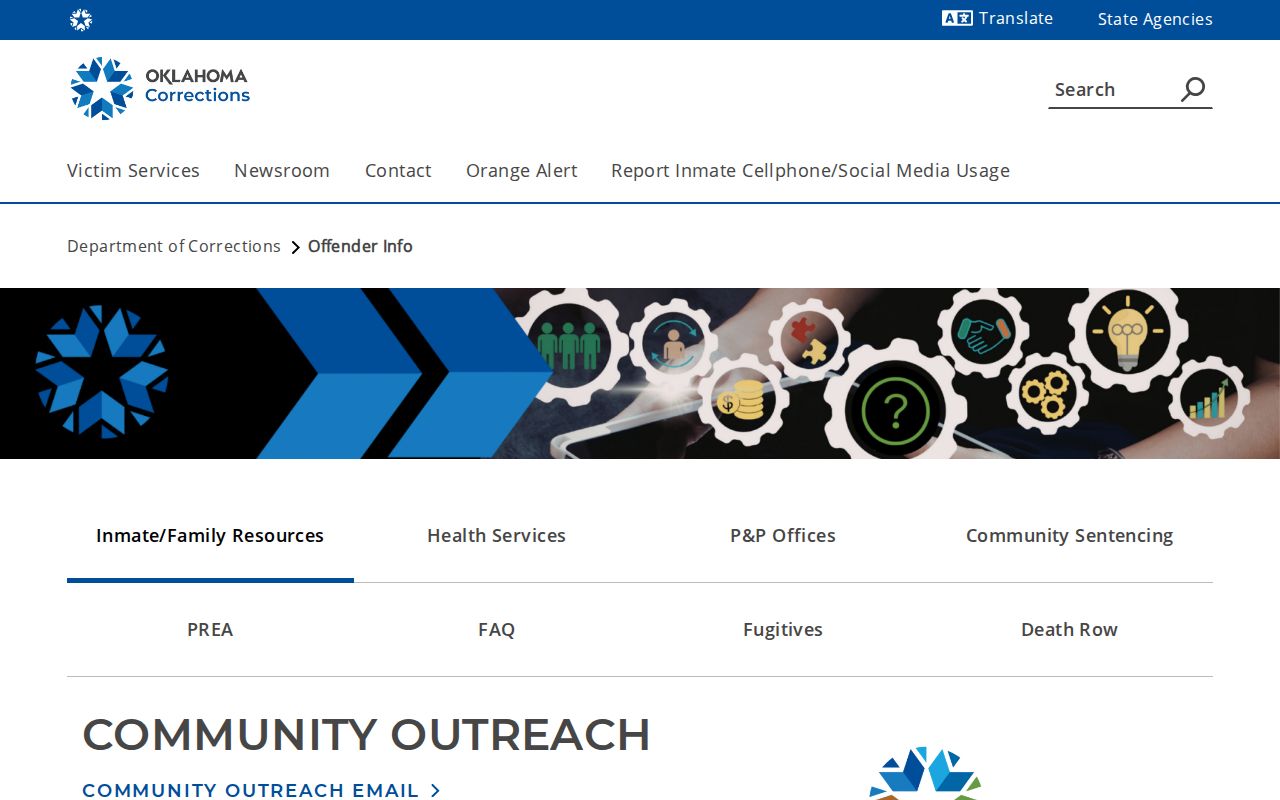
The inmate, facility records officer, and case manager may have access to the current days-remaining calculation. Victims are directed by ODOC to Victim Services at 405-425-2607 or victim.services@doc.ok.gov. Other requesters can review the ODOC Legal Services open-record and authorization routes, but the agency may withhold confidential material.
Note: A screenshot preserves what a public profile showed on one date; it does not freeze the sentence calculation or prove a later release event.
Garfield Release Dates and Earned Credits
Oklahoma's earned-credit law is 57 O.S. §138. ODOC implements it through policy that includes OP-060107. The statute and policy use credit levels. At Level 1, the basic monthly rate is zero credits. Level 2 provides 22, Level 3 provides 33, and Level 4 provides 44. These figures are inputs, not a do-it-yourself release calendar.
| Earned-credit level | Basic monthly credits | What the figure means |
|---|---|---|
| Level 1 | 0 | No basic monthly earned credits at this level |
| Level 2 | 22 | Current classification may reduce time under applicable rules |
| Level 3 | 33 | Rate still depends on eligibility and actual credit history |
| Level 4 | 44 | Highest basic monthly level does not override statutory limits |
A real ODOC computation must apply the current law, offense date, sentence date, classification, exclusions, and earned-credit history. Level can change. Misconduct or nonperformance may remove credits. Achievement credits may apply. Section 138(C) permits consideration of credit restoration, but ODOC describes restoration as discretionary rather than a right.
Sentence structure matters too. Concurrent terms run together to the extent the judgment permits. Consecutive terms run one after another. Presentence jail credit, an amended judgment, a revocation, or a new case may change the remaining term. Multiplying one monthly rate by the stated sentence ignores these controls and should never be presented as an official Garfield County projected release date.
Garfield Release Dates and the 85% Rule
The Oklahoma 85-percent rule does not apply to all felonies. Under 21 O.S. §13.1, a person convicted of an enumerated offense must serve no less than 85 percent of the sentence, and earned credits cannot reduce confinement below that floor. The conviction statute and the law applicable to its date must be checked against the enumerated list.
Informal labels are not enough. An offense that someone calls violent may not be one of the precise offenses listed in §13.1, and an enumerated offense cannot be treated like an ordinary earned-credit case. The judgment and sentence provide the starting conviction information. ODOC then administers the sentence under the controlling law.
Parole eligibility is another calculation. PPB broadly describes violent-offender eligibility as 85 percent and nonviolent eligibility as one-third, but 57 O.S. §§332.7 and 332.8 and offense-specific rules control. Eligibility permits Board consideration. It does not guarantee parole, create an actual release date, or end the sentence.
Keep three dates separate: parole eligibility, projected discharge, and actual release. The first opens a possible review. The second estimates sentence administration. The third records a completed custody event. Confusing them can make a Garfield County timeline appear far more certain than the official record allows.
Why Garfield Release Dates Change
A projected date can move in either direction as ODOC applies new information. Some factors alter credit. Others change the sentence itself or prevent release even when one term reaches its endpoint. The latest official calculation is more useful than arithmetic based on an old profile.
| Factor | Possible effect | Best record to check |
|---|---|---|
| Credit-level change | Changes the rate at which eligible credits accrue | ODOC calculation and classification record |
| Misconduct or nonperformance | Can reduce or remove credits and move the estimate later | ODOC sentence-administration record |
| Achievement or restored credits | May move an estimate earlier when law and agency action allow | Current ODOC credit history |
| Amended court order | Can change sentence length, credit, or structure | Garfield County docket and signed order |
| Concurrent or consecutive terms | Controls whether terms overlap or follow one another | Judgment and ODOC computation |
| Detainer, warrant, or new case | May keep the person in custody or cause transfer after a term ends | Holding agency, court, and receiving-agency records |
| Parole action | May create a supervised-release route but still requires final action and processing | PPB result, Governor action when required, and ODOC status |
A detainer is a request or authority for another agency to take or hold the person. It can turn what looks like a release into a transfer. A parole recommendation may still need Governor approval. A nonviolent grant may still precede processing. None of these events should be converted into a physical exit time without the later custody record.
Garfield County Jail Release Timing
County detention requires a different method. The public Kinetic list displays only first, middle, and last names plus booking date. It does not publish bond, sentence, projected release, actual release time, or destination. A missing name is only a lead. GCCJA runs daily detention operations, while Sheriff Cory Rink remains a board trustee and the Sheriff's Office handles transports. The person might have bonded out, completed local time, entered another facility, gone to court, or transferred to ODOC.
For a sentenced county term, read the actual Garfield County judgment and sentence. Do not add the stated term to a docket date and declare an exit. Presentence credit, concurrent or consecutive terms, later orders, and other holds can change the outcome. Then ask GCCJA for the existing jail-register entry when release occurs. Oklahoma jail-register law calls for the date or manner of discharge or escape if that information is kept in the covered record.
For a person awaiting trial, follow bond and court entries but wait for jail confirmation. A bond posting or dismissal can occur before staff receive the order, check holds, finish documents, and return property. The court explains legal authority. GCCJA records the local custody exit. If the record says transfer, the named receiving agency becomes the next source.
No official source reviewed states a routine release hour, weekend rule, or Garfield County jail good-time formula. Those points should be confirmed directly rather than borrowed from another Oklahoma county. Published administrative office hours also are not a release schedule.
Note: Garfield County court action can authorize release, but the jail-register discharge field is the stronger record of completed physical processing.
Confirm Garfield County Release Dates
After the projected date passes, check again. For ODOC custody, compare the updated status with any parole result and request the discharge record if the public display is unclear. ODOC Legal Services lists an open-record route, a closed-records contact, an authorization form for incarceration and supervision records, and osordischarges@doc.ok.gov for discharge matters.
For county custody, ask GCCJA for the actual date and manner of discharge and any receiving agency recorded. Review the Garfield County docket to understand the order or sentence behind that event. If the person transferred to state custody, allow time for ODOC intake before treating a missing state result as proof that the transfer failed.
OK VINE may add a custody-change notice when the supplying agency participates, but the alert does not replace the originating record. The Garfield County VINELink check explains registration and local limits. A notice can arrive before or after another system updates, and a transfer alert does not necessarily mean release to the community.
Use a clear evidence order: the jail for a county exit, ODOC for state custody or discharge, PPB for Board action, and the court for filed orders. Record each lookup time. When facts conflict, ask the office responsible for that specific event to correct or explain its record.