
No Garfield County Release Feed
No official Garfield County list of people released during the last 24 hours was verified in the county sources. The Garfield County Criminal Justice Authority site links to “Active Inmates.” Its Kinetic Console destination is labeled “Inmate List,” and the public table has no released-today tab, release-date filter, archive, or release-time column. The Garfield County sheriff page also supplies no separate same-day release link. That absence is a finding about the website, not about the records held inside the detention operation.
The first useful step is therefore direct confirmation from GCCJA. Ask for the existing jail-register or booking entry that shows the actual custody-ending event. State that the answer must distinguish a community release from a transfer. A person can leave the Garfield County Detention Facility roster after bond, time served, a court order, a medical move, extradition, or transport to another custodian. Only some of those paths mean the person went free in the community.
Verify the exit: Disappearance from the Garfield County active roster signals a possible custody change, but it does not prove release home.
Check Garfield County Same-Day Releases
A same-day Garfield County inquiry works best as a short evidence chain. Each source answers a different part of the question. The active list provides a current observation. GCCJA owns the operational jail record. The Garfield County Court Clerk preserves the order or case event that may have authorized release. VINE can add a custody-change notice when the person and supplying agency can be matched, while ODOC becomes relevant only when the person entered state custody or supervision.
- Open the official Garfield County active-inmate list. Look through its pages or use the browser's find tool, since the captured table has no public name-search box.
- Save the exact first, middle, and last name, the displayed booking date, the URL, and the time of the observation. These details help GCCJA distinguish similar names.
- Call GCCJA at 580-548-2429 or confirm how to submit a focused request at 1020 South 10th Street, Enid, OK 73701. Ask for actual release date and time, release disposition, and destination if transferred.
- Check the Garfield County OSCN route or ODCR for a bond entry, dismissal, judgment, sentence, or later order. Treat it as legal authority, not the jail's physical-exit time.
- If the record shows state transfer, use OK Offender Lookup. If notification matters, search Oklahoma VINE and confirm that Garfield County is offered by the live system.
For a search focused on one known person rather than all same-day exits, the Garfield County released-inmate search path brings the county, court, state, and federal routes together. Keep identity checks strict. A shared name does not establish that two records describe the same person.
Note: Record the observation time because roster removal, a court filing, a notification, and receiving-agency intake may appear in a different order.
Garfield County Release List Fields
There is no official 24-hour table whose release fields can be reported. The public Garfield County active list visibly provides only four columns. A release confirmation requires additional fields from an existing GCCJA record. The distinction below prevents the current roster from being read as a release ledger.
| Field | Garfield County availability |
|---|---|
| First, middle, and last name | Visible as separate columns on the active-inmate table. |
| Booking date | Visible on the active table and useful for identifying the booking. |
| Booking or inmate identifier | Not visible in the table; ask for it in the GCCJA record. |
| Actual release date and time | Not visible; request the custody-ending timestamp from GCCJA. |
| Release type or disposition | Not visible; request the recorded manner of discharge. |
| Destination or receiving agency | Not visible; request it when the exit may have been a transfer. |
A focused request can seek “records sufficient to show” the booking and actual custody-ending event. That wording allows the custodian to return the jail-register entry, booking sheet, movement record, or other existing item that holds the facts. It does not ask staff to create a new report. Include the known booking date or a narrow date range, and ask separately for a booking photograph only when it is needed.
Garfield County Roster Release Limits
The official GCCJA-linked active roster shows exactly why a same-day release cannot be proven from the public table alone. Its columns identify listed people and their booking dates, but no control changes the view to releases from the past day.
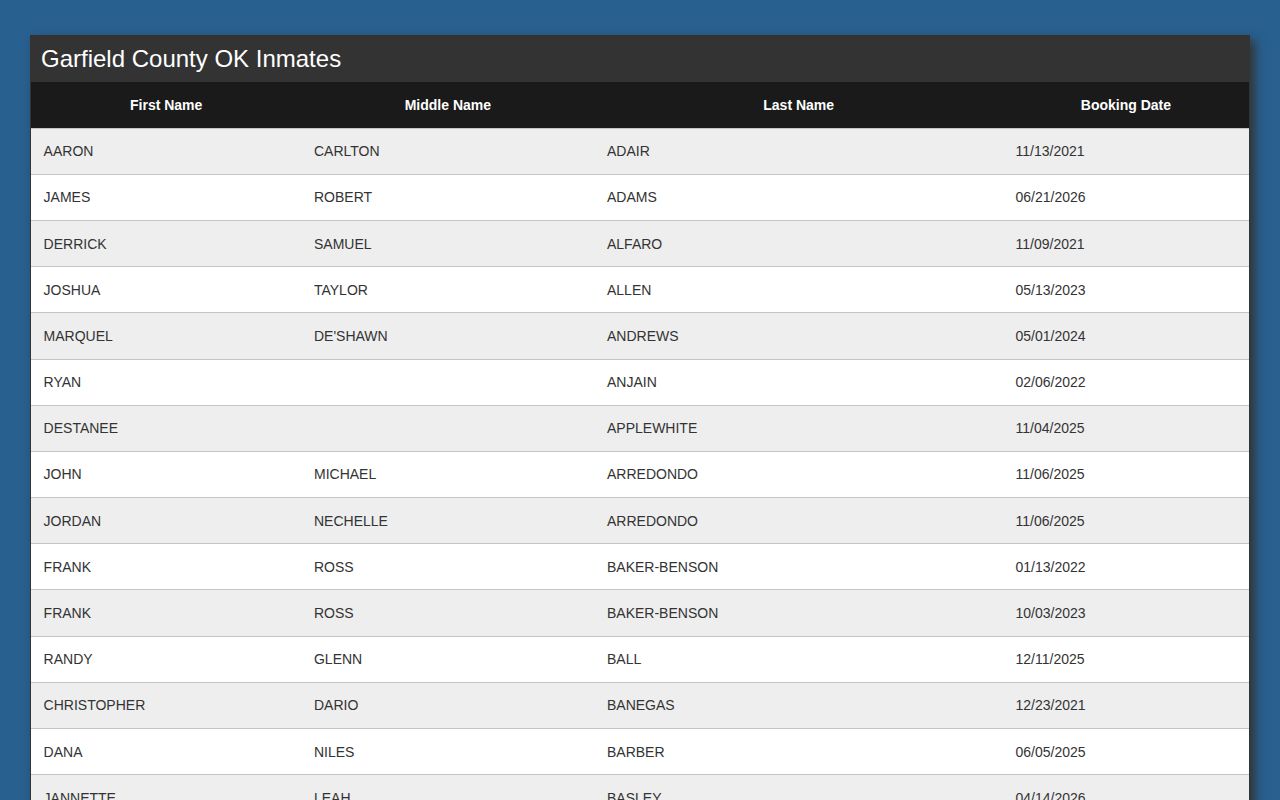
The captured Garfield County roster is useful for documenting that a name was active at a point in time. A later absence calls for a GCCJA discharge record, since the image does not disclose when, why, or where the person left local custody.
Note: The roster's page count is a momentary display and must not be treated as a daily booking or release total.
Garfield Release Register Versus Roster
The live website and the legal jail register are not the same record. Oklahoma's Open Records Act, at 51 O.S. §24A.8(A)(8), addresses access to jail registers, blotter data, or booking information that includes the date or manner of discharge or escape when kept. Title 51 provides the statutory text. Title 57 §48 also requires a jail register and permits a computer record to serve as the original.
This legal distinction matters in Garfield County because the public interface omits all discharge fields. An online list can be brief and current-only while the underlying record preserves the custody exit. Ask for the existing register and booking entry for the named person and booking date. Add the recorded discharge date and manner, plus a transfer destination if maintained. The request should go to GCCJA as daily operator, not merely to the sheriff, whose stated role includes transports but not daily jail control.
A court docket is still valuable. It may show bond activity, dismissal, judgment, sentence, or another order. Yet the court does not certify the moment Garfield County jail staff finished identity checks, resolved holds, returned property, and completed the physical exit. Pair the court event with the register entry.
Garfield Release Display and Retention
Website display, operational retention, and lawful disposition are three separate issues. Neither GCCJA nor the Kinetic roster publishes an archive duration, update schedule, or local retention period. Garfield County therefore has no verified basis for saying a former detainee remains online for a day, disappears at a fixed hour, or becomes unavailable after any set span. The public list is simply an active-inmate presentation at the time it is viewed.
Oklahoma records schedules govern retention, and 19 O.S. §517.1 allows a county governing body to set retention for departmental records not otherwise addressed. The Oklahoma Archives and Records Commission guidance explains the role of formal disposition schedules. Since no Garfield-specific detention schedule was found, ask GCCJA for the schedule that applies to the requested booking or register record. Do not substitute a general estimate.
Prompt, reasonable access is the state-law standard. It is not a universal deadline. Garfield County also publishes no dedicated GCCJA request form, fixed copy fee, or promised turnaround for these records. Confirm the submission method, ask whether a cost will apply, request an estimate, and prefer a narrow electronic copy when available.
Garfield County Release Paths Today
A release disposition gives meaning to the timestamp. Bond, own-recognizance release, time served, sentence completion, dismissal, or a court-directed release may lead to the community. A transfer to ODOC, another jail, a medical or mental-health facility, or an extraditing authority ends Garfield County custody without ending custody as a whole. That is why a same-day list, even if one existed, would need a release reason and destination to answer “who got out” with care.
When the Garfield County court docket shows bond or dismissal, allow for the jail's processing steps and for any other hold. A legal order can precede physical release. When GCCJA records transfer to ODOC, search the state system after intake rather than describing the person as free. OK Offender Lookup covers state custody and ODOC community supervision, not each county-only release. VINE is a notification aid, not the creator of the release record.
- Community release
- An exit from custody to the community after lawful processing.
- Transfer
- A move from Garfield County custody to another agency or facility.
- Disposition
- The recorded reason or manner by which local custody ended.
- Detainer
- A hold from another authority that can prevent or redirect release.
Note: A release authorized today may still require records from more than one agency when another case, warrant, or detainer is involved.
Garfield Releases and Current Custody
The correct next source depends on what happened after the Garfield County booking. A live-roster match points to apparent current local detention, subject to normal display lag. A GCCJA record of community release confirms the local exit. A transfer notation sends the search to the named custodian. Court evidence can explain authority, but it cannot replace the operational discharge record.
| Situation | Best Garfield County evidence | What it proves |
|---|---|---|
| Name is on the active list | Time-stamped roster observation | The person was publicly listed as active at that moment. |
| Name drops from the list | GCCJA jail-register or booking entry | The actual date and manner of the local custody exit. |
| Court appears to authorize release | OSCN or ODCR docket plus GCCJA entry | The legal event and the separate physical release event. |
| Record says transfer to ODOC | GCCJA transfer entry plus OK Offender Lookup | The end of county custody and possible continued state custody. |
For a wider observation period that can bridge several roster checks, use the Garfield County 72-Hour Release List. It uses the same official evidence sources but is organized around a three-day review instead of a same-day question.