
No Garfield County 72-Hour Feed
The official Garfield County sources reviewed do not publish a rolling 72-hour release view. The GCCJA operator website provides one public custody link, labeled “Active Inmates.” That link opens a current Kinetic table rather than a recent-release archive. No three-day control, date-range release search, release-time field, 48-hour page, or prior-release tab appeared on the operator, sheriff, or roster pages.
This means the public cannot reconstruct a complete three-day Garfield County release list from the website alone. It does not mean no releases took place. It also does not mean GCCJA lacks an internal discharge or movement record. The practical substitute is to preserve what the active table showed at each observation, then ask the daily jail operator for the existing record of the custody-ending event. A docket or receiving-agency record can then explain the path.
No inferred release: A Garfield County name missing after three days remains an unresolved custody change until the discharge or transfer record confirms it.
Review Garfield County Three-Day Releases
A three-day review is built from dated evidence, not from a hidden filter. Begin with the official active list and preserve enough detail to compare observations. Then seek positive proof from the office responsible for the event. GCCJA records the local jail exit. The Garfield County Court Clerk records filed case events. ODOC, another jail, or a federal authority records later custody when the local exit was a transfer.
- Open the official Garfield County active list at the start of the period. Check each page or use browser find, because the table does not show a public name-search field.
- Save the exact displayed name, middle name, booking date, URL, and observation time. Repeat the check within the three-day span rather than relying on memory.
- If a previously listed name vanishes, contact GCCJA at 580-548-2429. Confirm the current request method and seek the actual date and time, manner of discharge, and receiving agency if transferred.
- Search the Garfield County OSCN page and ODCR for bond activity, dismissal, sentence, or another order. Match the case carefully and do not treat filing time as physical release time.
- Follow a transfer through the correct system. Use OK Offender Lookup for ODOC custody, the named jail for another county transfer, and the applicable federal source for federal or immigration custody.
Use Oklahoma VINE as an added notification channel, not as the official register. Participation and the live Garfield County agency choice should be confirmed in the current system. A missing VINE result is inconclusive because agency participation, spelling, retention, transfer, and interface behavior can all affect what appears.
Note: Keep each lookup time beside its result so the three-day sequence remains clear when records or notifications appear later.
Garfield County 72-Hour Release Fields
No official Garfield County 72-hour table exists from which a set of published release columns can be copied. The current roster provides names and a booking date. Those fields help locate the right booking, but they do not answer when or why custody ended. A complete three-day review should seek the following facts from GCCJA's existing records.
| Field | What it establishes |
|---|---|
| Full name and booking identifier | Connects the release event to the right Garfield County booking. |
| Booking date and time | Separates the custody start from the public table's date-only display. |
| Actual release date and time | Places the processed custody exit within or outside the three-day period. |
| Release disposition | Distinguishes bond, time served, court release, dismissal, or another recorded manner. |
| Destination or receiving agency | Shows whether the person entered the community or remained in another authority's custody. |
| Related booking date | Helps separate repeat bookings or people who share a similar name. |
Ask for “records sufficient to show the booking and actual custody-ending event” for the full name and a narrow booking-date range. Add the actual release date and time, release disposition, destination or receiving agency if transferred, and booking identifier. This phrasing allows GCCJA to locate a jail-register entry, booking sheet, or movement history without requiring a newly written report.
Garfield Releases Across Closed Days
A wider window is especially useful when the period crosses days on which a records office or court counter is closed. The Garfield County Court Clerk publishes weekday public hours and excludes holidays. Jail custody processing is a separate operational function, so the time a court event becomes easy to view or obtain may differ from the time GCCJA completed the exit. No official local source promises that either public system posts changes on a fixed cadence.
Build the timeline from the dates that each source actually provides. A bond entry or release order may explain the legal authority. The GCCJA record supplies the physical custody-ending time. If another hold was active, the same court action may not produce a community release. If the person was transported, the receiving agency's intake can occur after the Garfield County roster changes. These are related events, but their clocks need not match.
The three-day method catches more than one snapshot, yet it does not turn negative evidence into proof. If a name was present before a weekend and absent after it, report only those observations until GCCJA confirms the discharge or transfer. The Garfield County 24-Hour Release List applies the same standard to a tighter same-day inquiry.
Note: A court counter schedule does not set the Garfield County jail's release schedule or prove when an individual left the building.
Garfield County Release Roster Evidence
The GCCJA-linked active list is the right official public page for observing who is currently displayed. The captured interface explains why it cannot serve as a three-day release report: it shows only first, middle, and last names plus booking date, with pagination and page-size controls.
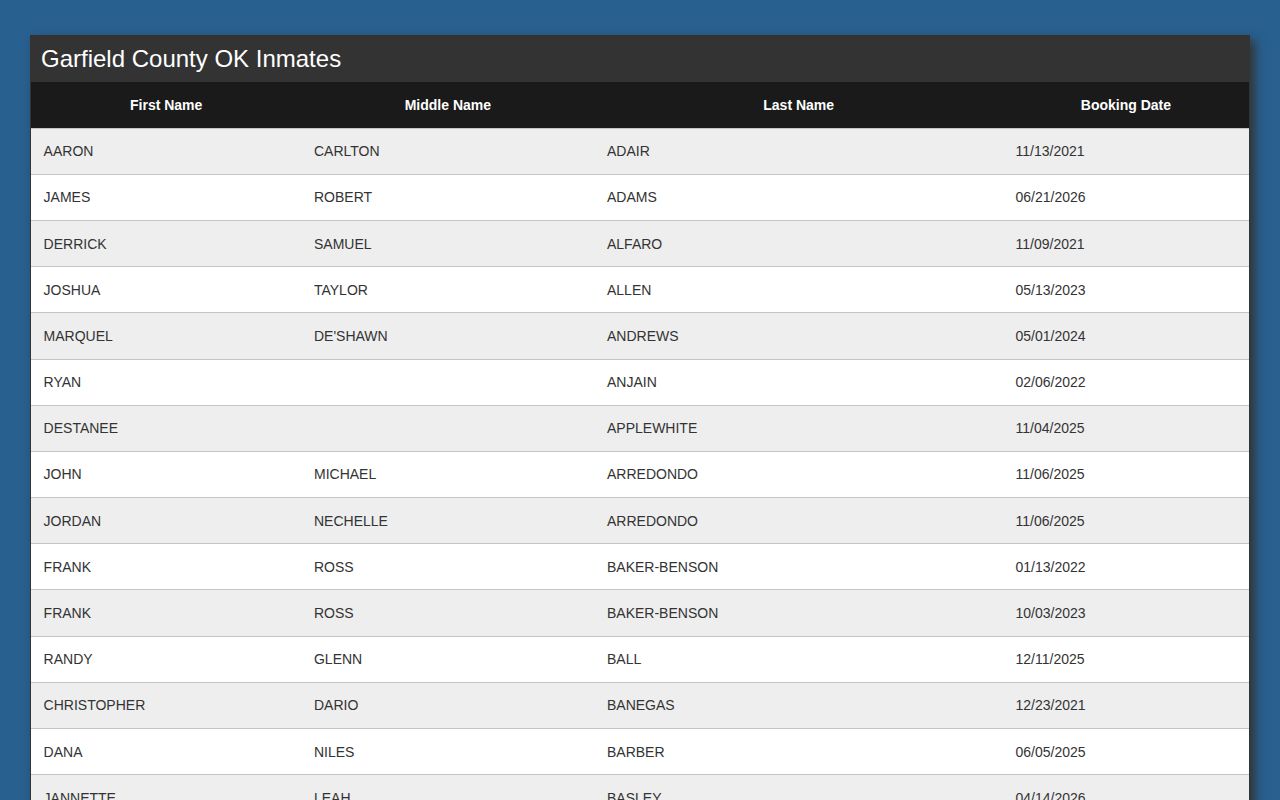
The image documents the roster's limits at the research observation. It contains no actual release time, release reason, transfer destination, booking photo, or switch to former detainees. The roster is therefore a starting snapshot for a Garfield County three-day comparison, not the final proof of who entered the community.
Garfield Release Register Versus Roster
Oklahoma law separates the sparse web display from the legal record used to verify discharge. Section 24A.8(A)(8) of Title 51 addresses access, if kept, to jail-register, blotter, or booking information that states the date or manner of discharge or escape. The official Title 51 text supplies that rule. Title 57 §48 independently requires the jail register and allows a computer record to be the original.
That distinction is crucial for Garfield County. The website may stop displaying a person because it is a current-only roster, while the register continues to hold the custody-ending entry. The lack of an online three-day archive does not erase the legal record or prove that the underlying record was disposed of. Ask GCCJA for the existing entry rather than requesting a custom rolling list that the public interface does not provide.
The response should be read for manner as well as date. “Transferred” means Garfield County custody ended but another custodian received the person. A community disposition has a different meaning. If a transfer destination is kept, request it. Then use that destination's record to continue the chain. The legal register and active roster answer different questions and should not be treated as duplicates.
Request Garfield County Release Records
The daily operator is the Garfield County Criminal Justice Authority at Garfield County Jail, 1020 South 10th Street, Enid, OK 73701. Its published office telephone is 580-548-2429 and its fax is 580-548-2469. The research found no dedicated GCCJA records email, downloadable request form, fixed local fee table, promised response time, or stated record-retention period. Confirm each of those points with the office before sending private identifying details or assuming a deadline.
A narrow request is easier to locate and less likely to require clarification. Give the full name, the booking date or limited range, and any known booking identifier. Ask for the existing jail-register and booking entry, actual date and manner of discharge, and receiving agency if the record has one. Request an electronic copy when it will meet the need and ask for a cost estimate before copies are made.
Oklahoma's Open Records Act calls for prompt, reasonable access, not one fixed number of days for every request. Reasonable direct copy costs may apply. Since Garfield County publishes no specific GCCJA schedule or fee for this task, figures from other agencies should not be borrowed. The state's records-management guidance explains that formal disposition schedules govern retention, while 19 O.S. §517.1 permits county action for departmental records not otherwise covered.
- Jail register
- The formal custody record that includes the required discharge information when kept.
- Disposition
- The stated manner in which the Garfield County custody event ended.
- Receiving agency
- The authority that takes custody after a transfer.
- Archive
- A retained historical collection, which the public active list is not shown to provide.
Note: Ask GCCJA which local retention schedule governs the record because no exact Garfield detention period was verified.
Garfield County Release Fallback Chain
When the three-day web comparison is unclear, move through the offices according to what each one controls. GCCJA documents the local custody exit. The Garfield County Court Clerk maintains district-case records and dispositions. Its docket can show a bond order, dismissal, judgment and sentence, modification, or another filing related to the expected release. Yet the court record does not certify when jail staff processed the physical exit.
If GCCJA records a transfer to ODOC, use OK Offender Lookup after intake. That service covers people with state custody or supervision records, not each person who leaves the county jail. If the destination is another county facility, contact that named detention authority. VINE may report a custody change when the supplying agency participates, but the originating record remains stronger proof.
| Three-day finding | Next source | Question to resolve |
|---|---|---|
| Name remains on active list | GCCJA active roster or office | Is local custody still current? |
| Name disappeared | GCCJA jail register | When and how did local custody end? |
| Bond or dismissal appears | Court docket plus GCCJA entry | Did the legal event result in physical release? |
| Transfer appears | Named receiving agency | Where did custody continue? |
| Older local event is needed | GCCJA record request and court file | What retained record documents the past exit? |
When the goal is to trace one specific former detainee through every possible custody class, use the Garfield County released-inmate lookup. A three-day roster comparison is most useful for identifying a change window. The named-person workflow is better for following a county exit into state, federal, immigration, or supervision records.